
Technical information
Understanding the technology behind our tires helps you get the most out of every journey. In this section, you will find technical information about our tires and their performance.
Sidewall Markings
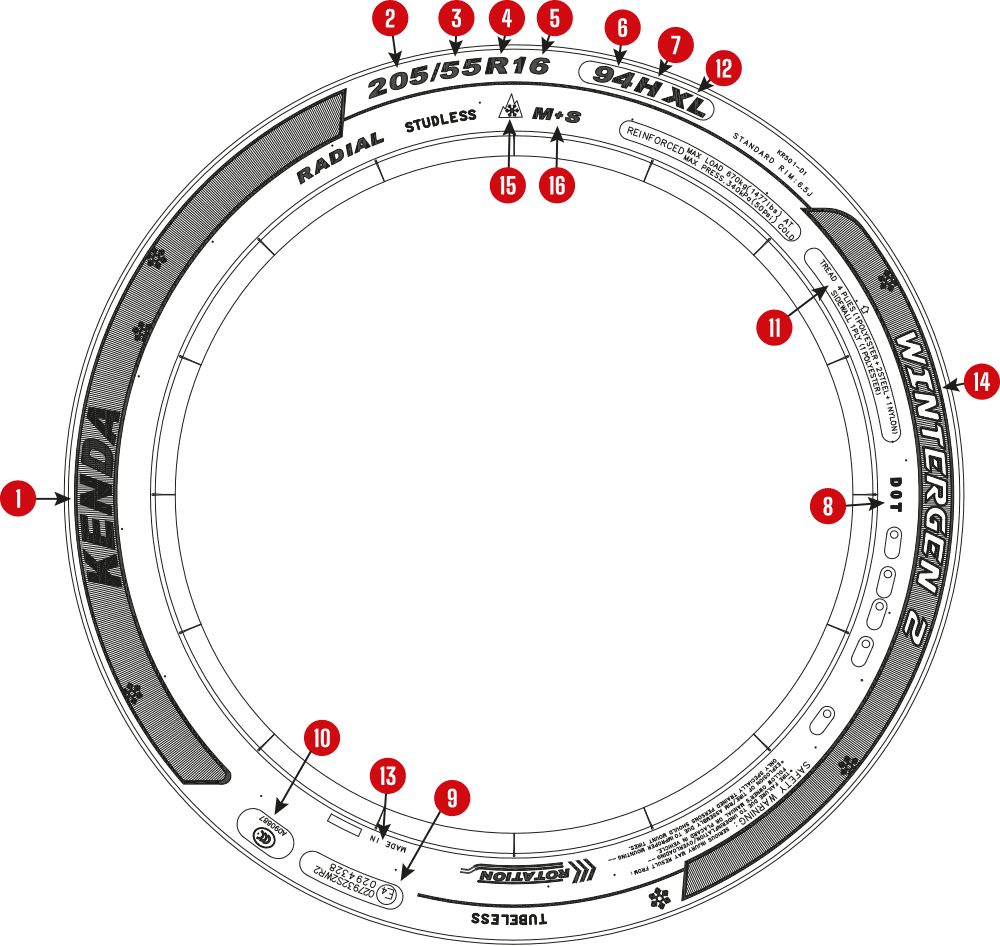
- Brand
- Tire Width
3-digit number that gives the approximate tire width in mm. It measures from sidewall to sidewall. Typically, the higher the number the wider the tire. - Aspect Ratio
2-digit number that gives the approximate sidewall height. It is expressed as a % of the tire width. The lower the ratio, the smaller the sidewall height. - Construction
R = Radial Ply
Radial tires are the industry standard and refers to the internal plies being 90 degrees to the direction of travel - Wheel Diameter
2-digit number (in inches) that indicates the tire is designed to fit on a wheel with a 16-inch diameter. - Load Index
2-digit number that indicates how much weight the tire is certified to carry at maximum safe inflation. - Speed Rating
1 letter which indicates the top speed at which a tire is certified under specified conditions. - DOT Codes
This assures that your tire complies with all Department of Transportation (DOT) safety standards. The next two numbers or letters are the plant code where it was manufactured. The last four numbers represent the week and year the tire was built. For example, the numbers 2212 mean the 22nd week of 2012. The other numbers in the middle are used at the manufacturer’s discretion as a code. This information is used to contact consumers if a tire defect requires a recall. - ECE Approval Number
An E with a number in a circle assigned by the Economic Commission for Europe, that declares the tire meets the minimum safety requirements of all directives applicable in the EU. - CCC Mark
- Structure Details
- Extra Load
XL is the marking for an extra reinforced tire in order to expand the load capacity. - Country of Origin
- Pattern Name
- 3PMSF
The three peak mountain snow flake symbol proves the minimum required performance in winter conditions, the so called snow grip index under the EU regulation 661/2009. - M+S
It marks the tire with the feature of having a good traction on Mud and Snow, but it does not qualify the product as a winter tire.

3PMSF Marking
Tires developed to provide proper performance also in winter conditions allow better grip on snow, reduce fuel consumption and provide excellent traction, due to a specially designed tread. They decrease the braking distance and guarantee better driving conditions, increasing safety. From November 2012, UNECE Regulation 117, to be implemented in the EU through Regulation (EC) 661/2009, requires that for tires to be used in winter conditions a minimum level of performance on snow (braking and traction) needs to be achieved. If the tire meets the criteria of an ad hoc
performance test, it can be marked with the new three-peak mountain snowflake (3PMSF) symbol as an additional but not mandatory marking. The “M+S” marking, however, will remain as an allowed marking, even if not linked by law to a minimum threshold in winter conditions.

M+S Marking
M+S stands for “Mud + Snow”. It is a declaration that the tire operates in mud and snow better than regular models. The marking is also shown on winter tires but not all tires with “M+S” have winter properties. “M+S” letters are also on some all-season tires. The marking is additionally used on models sold in the US market, even though they do not meet the needs of drivers in the winter season. In general, “M+S” tires should have very soft rubber compound and a tread with more incisions to ensure better performance in the snow. Unfortunately, these features are not verified by standardised tests and may be unreliable.
